Module 01 / A first workflow
AI agent fundamentals
In progressBuild a small AI workflow, understand where ordinary code ends and model judgment begins, then learn what would make it an agent.
Local prototype built · exploratory model calls recorded · broader evaluation and agent loop pending
01 / What was built
Ask a saved article. Inspect the evidence.
A small local prototype accepts article text and a question, retrieves candidate passages, asks a model for a cited answer, and checks its references. This public page is a write-up. It does not run the model or accept article uploads.
Building effective agents
Source: Anthropic. Question: “How do workflows and agents differ in who controls the process?”
A cited answer with a misleading claim
The model returned multiple claims with matching source quotes. One claim blurred the article’s distinction between broad uses of the word “agent” and its specific architectural definition. Passing the quote check did not establish answer quality.
Why this is a workflow
Code picks the passages, makes the model request, and validates the output. The model writes an answer but cannot choose another tool, search again, or change the sequence. An agent loop has not been built.
Where it might be useful
Revisiting a growing collection of saved reading. For a couple of articles, putting them in an existing chat may be simpler. This prototype has not demonstrated a usability or quality advantage over that baseline.
02 / What the experiment exposed
Three concrete observations
Context is selected by code
The model receives up to five passages selected by keyword overlap, not the whole article. This simple retrieval can miss useful wording. No embedding-based search was implemented.
A model call can finish without an answer
A free model used the per-request output allowance before emitting an answer. The app originally hid that behind a generic validation error. We increased the allowance, requested lower reasoning effort, and added specific error handling. This was a response-length limit, not an exhausted money balance.
A genuine quote can accompany a bad claim
A real article answer passed citation and exact-quote checks while still misinterpreting the source. Human semantic review remains necessary. Structural validation cannot substitute for it.
These are observations from the build session, not claims that the module is mastered. Personal takeaways remain to be written and reviewed by Andy.
03 / Verification and limits
What was actually checked?
14 software checks passed
Checks cover expected retrieval, no keyword matches, fabricated references and quotes, incomplete responses, empty answers, malformed JSON, and output parsing. One test deliberately demonstrates that a genuine quote can accompany an unsupported claim. This count is not an AI accuracy score.
Local app checks
Saving and removing an article, persistence after reload, passage search, and an accepted live answer were checked in the browser. Production compilation passed.
Exploratory AI calls
Synthetic examples and a real Anthropic article were tried. Results included an accepted supported answer, no retrieval matches, rejected outputs, incomplete responses, and a semantically misleading claim. These calls were not a controlled evaluation suite.
Still pending
A fixed representative question set, repeated trials, human support labels, and a comparison against simply asking an existing chat. No reliability percentage or evidence that an agent improves this task is claimed.
04 / Starting sources
Read the originals
Source material is separate from the experiment observations above. The first article informed the workflow-versus-agent distinction. The second is the starting reference for a more deliberate evaluation plan; that plan has not been completed.
Visual field guide / Design example
Who chooses the next step?
A workflow follows a route defined in code. An agent lets the model select actions using feedback. Branches, retries, and multiple LLM calls alone do not make a workflow an agent. This distinction follows Anthropic’s Building effective agents.
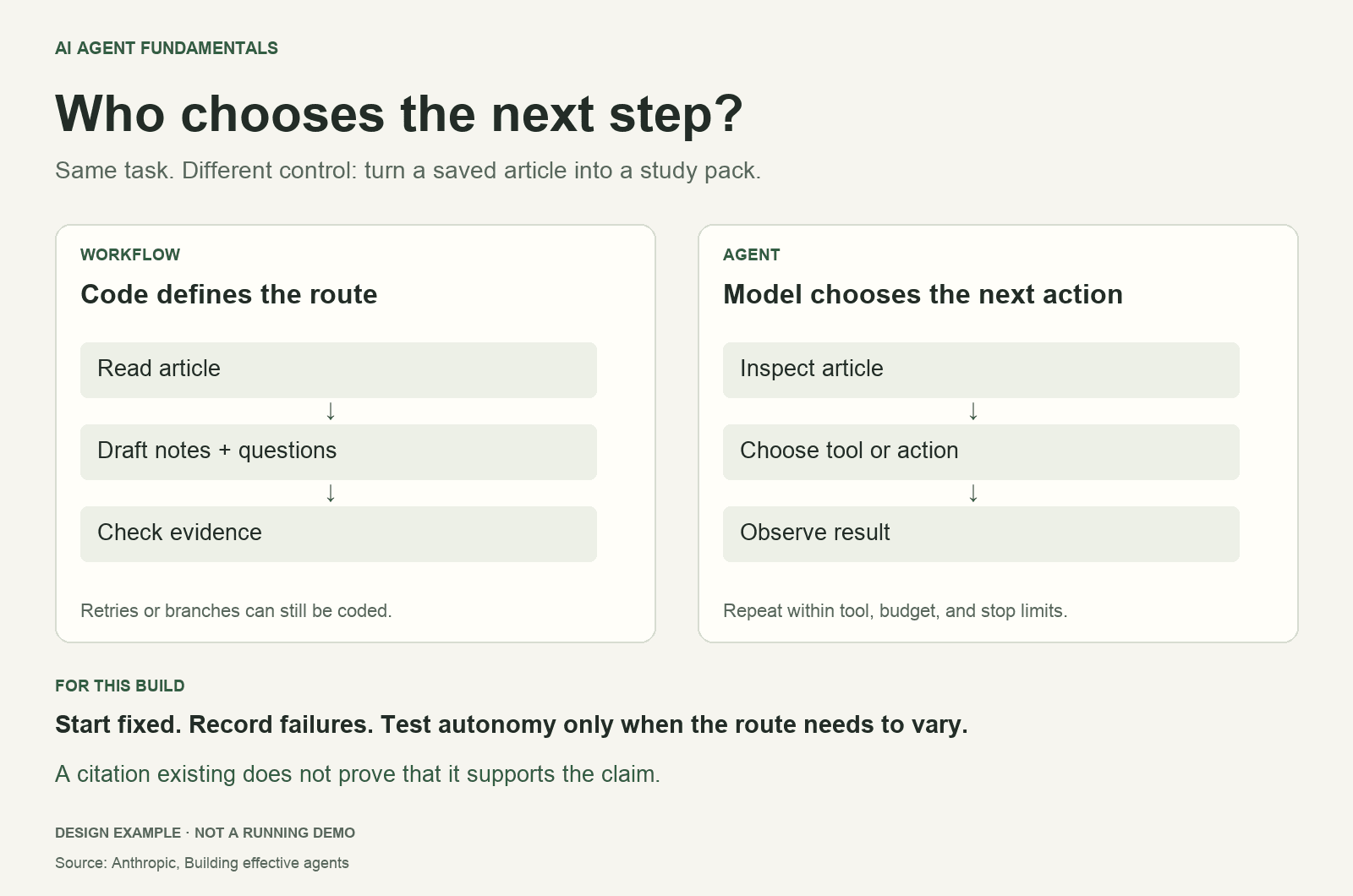
Apply it to an article-to-study-pack build
This is an editorial design recommendation, not a tested result or a personal takeaway approved by Andy. The saved article and requested output are known, so a fixed sequence is a reasonable baseline: prepare passages, generate notes and questions, validate structure, then review support.
A failure that needs a better check
A note cites passage P03, but P03 does not support its claim. Add a claim-to-passage review and reject or revise that note. Giving the model more autonomy does not establish factual support.
A failure that may justify adaptation
Different saved articles require different tools to recover their content. First try a coded route for known formats. If unseen cases repeatedly need different actions, compare a bounded agent with that baseline.
A decision you can use on your own project
- Write the smallest sequence that could solve the task. A single model call may be sufficient.
- Define success and save representative inputs before adding complexity.
- Classify failures: missing evidence, bad output format, or genuinely variable next steps?
- Test model-chosen actions only for the failures that need them. Limit available tools, actions, and spend.
- Use the same inputs to compare supported claims, supported answers, completion rate, latency, and cost. Keep autonomy only if the improvement justifies the tradeoff.
What would change this recommendation?
Evidence that the fixed baseline fails on useful inputs because it cannot select the right next action—and that a bounded agent improves those outcomes under the same review criteria. No such comparison has been run for this build yet.
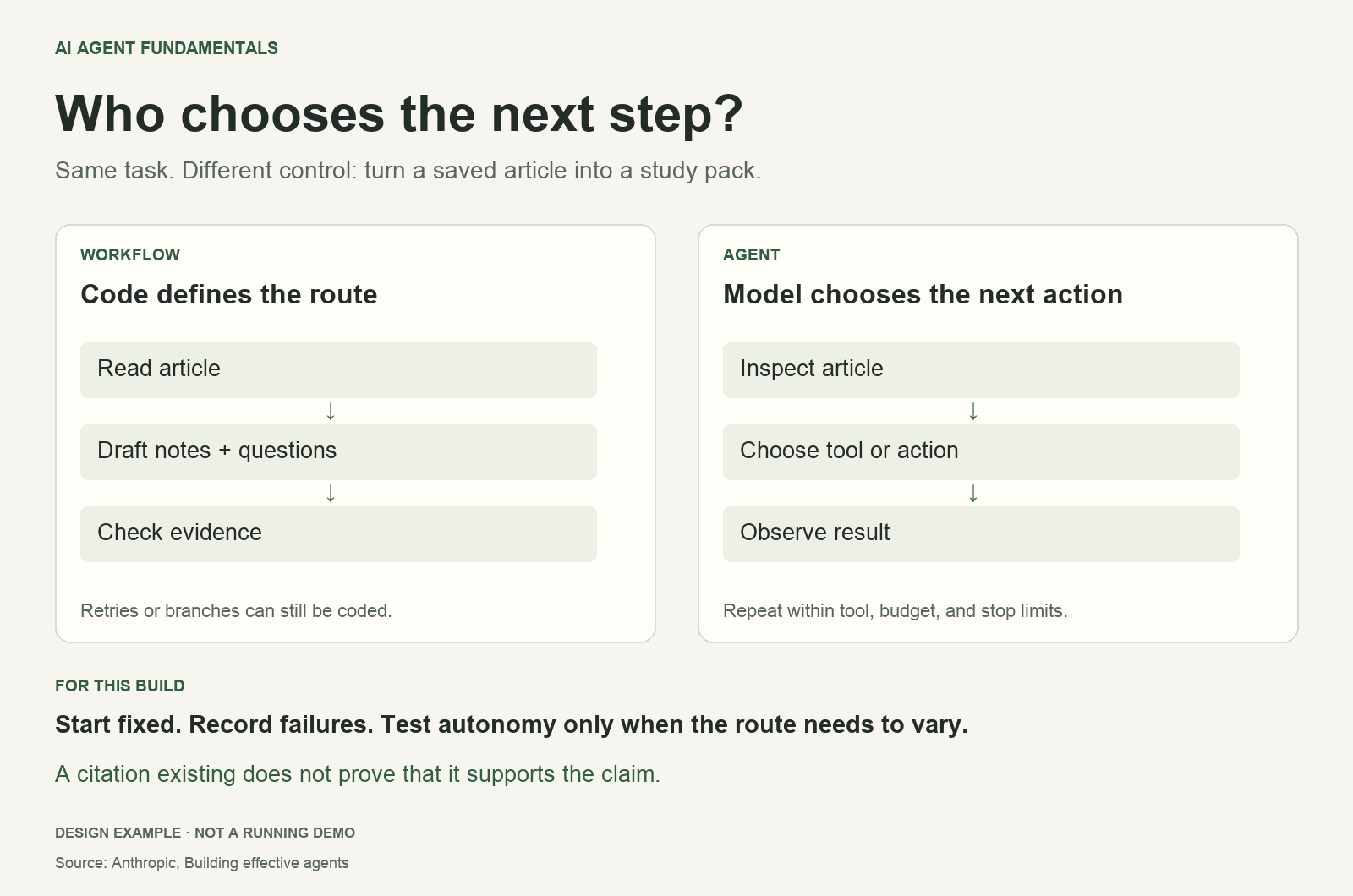
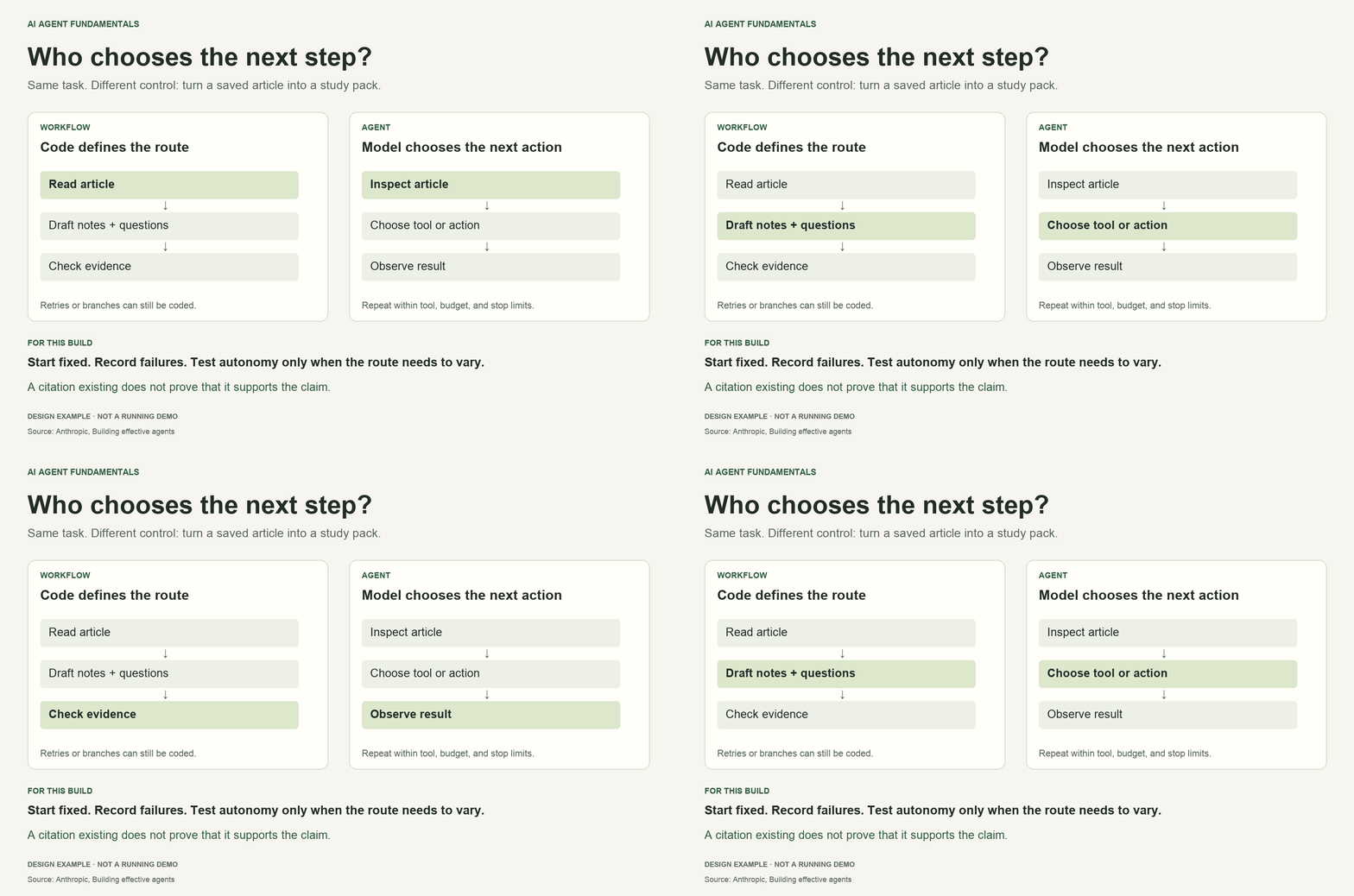
Animation highlights the design steps; it is not a recording of software executing. Sources explain the architecture; the decision checklist is an application to this proposed build.
05 / A reusable exercise
Change the context. Compare the answer.
- Pick a question with an answer in a saved article. Write down the passage you expect to support it.
- Ask the same model with that passage included, then with it omitted. Keep the question and instructions fixed.
- Record whether each answer is supported, incomplete, or unsupported. Check claims against the original text.
- Write what changed and what did not. Do not infer reliability from a single pair of calls.
This controlled exercise is proposed, not completed. Study-note and generated-practice-question automation remain future work.